The 12 Instruments
Keeping Africa Divided
This is not motivation. This is not inspiration. This is confrontation. Africa does not have a resource problem. Africa does not have a potential problem. Africa has a truth problem — and today, we face it.
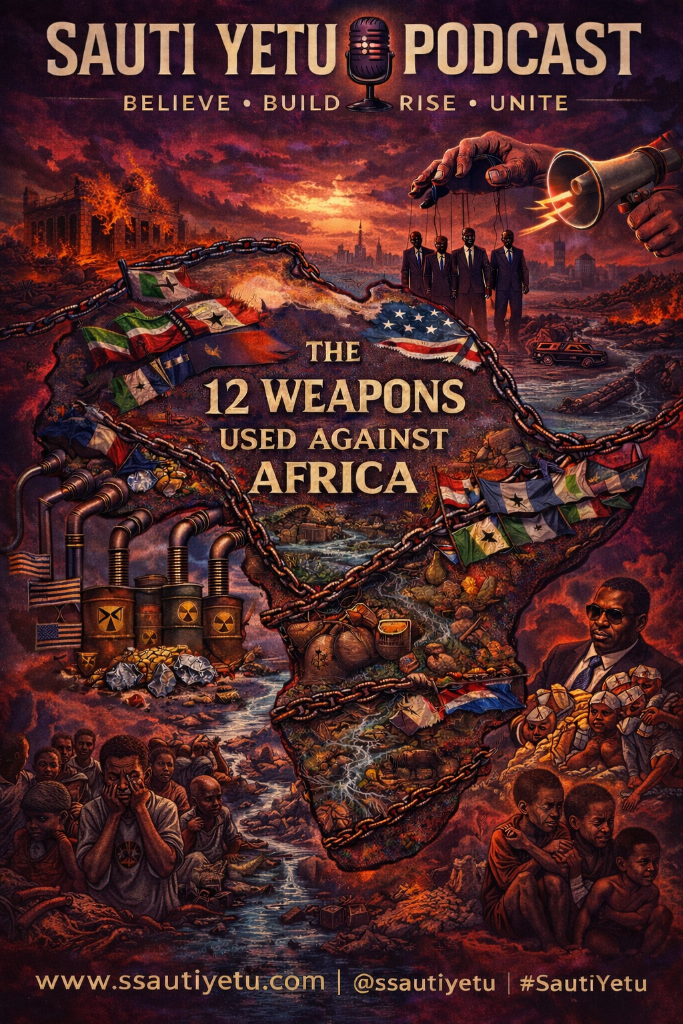
Sit down for this one. Because this is not motivation. This is not inspiration. This is confrontation. And until we face it — raw, uncomfortable, unfiltered — we will keep dancing in circles while the world moves forward using what we already own.
Africa does not have a resource problem. Africa does not have an intelligence problem. Africa does not have a potential problem.
Africa has a truth problem.
Today, we speak truth. Not the version that comforts you — the version that wakes you up.
Africa has a truth problem.
Twelve Instruments. One Fracture.
These are not opinions. These are instruments — tools, systems, mindsets — that together have kept a continent of more than a billion brilliant people from rising as one. Some are external. Some are internal. All of them are still in use.
Why we must name them
A thing unnamed cannot be fought. We have whispered around these forces for generations, hoping politeness would resolve them. It has not. So we name them plainly — twelve at once — so that no one can pretend they did not see.
The 12 Instruments
Colonial Borders — The Original Fracture
Africa was not divided by accident. It was divided with precision. Lines were drawn in rooms where no African voice mattered. Families split. Kingdoms broken. Enemies forced together.
Colonialism ended. But the borders stayed — because we accepted them. We defend artificial lines more than we defend our shared identity. As long as we protect those divisions, we protect the very system that weakened us.
Language — The Silent Wall Between Us
You can travel across Africa and feel like you've left the continent — not because of culture, but because of language. We are fluent in English. In French. In Portuguese. In Spanish. But we struggle to speak to each other.
A continent of over a billion people, still communicating through the voices of those who once ruled it. That is not communication. That is dependency disguised as normalcy.
Tribalism — Division At The Root
Before colonization, tribe was identity, not weapon. Now we use tribe to divide, exclude, and compete. "I am this before I am African." That mindset is costing us everything.
Because while we argue over tribe, the world sees one thing — Africa — and exploits it accordingly.
Leadership Without Loyalty
Africa does not just suffer from bad leadership. It suffers from misaligned leadership. Leaders who answer outward instead of inward. Leaders who protect positions instead of people.
Some of our leaders are not failing us — they are serving exactly who they were positioned to serve. You cannot build unity on leadership that benefits from division. Look at what is happening in the Democratic Republic of the Congo.
Economic Capture Disguised As Trade
Africa is rich in everything the world needs. Gold. Oil. Diamonds. Cobalt. Uranium. Land. Youth. But look closely: we export raw, we import finished. We dig — they design. We supply — they profit.
That is not trade. That is an economic architecture designed to keep Africa at the bottom of its own wealth chain.
Foreign Influence — Control Without Flags
Colonialism did not disappear. It evolved. No flags. No armies. Just policies. Currencies. Agreements. Decisions about Africa still pass through foreign approval systems.
And the most dangerous part? It feels normal.
Media — The Psychological Warfare
If you control the story, you control the identity. Africa is shown as hungry, broken, dependent. Rarely as brilliant, innovative, powerful.
And over time, something dangerous happens: we begin to believe the version of ourselves that was never true. A people who doubt themselves will never unite.
We Don't Build With Each Other
This one hurts. Africans do not prioritize African businesses. We trust foreign products more than our own. We invest outside before we invest inside. We complain about lack of opportunity — while ignoring opportunities next door.
Unity is not just political. Unity is economic behavior. And right now, our behavior is divided.
Education That Disconnects, Not Empowers
We are highly educated — but poorly grounded. We know global history but not our own. We can name foreign leaders but not African visionaries.
And because of that, we grow up aspiring to leave instead of building where we are. That is not education. That is mental migration before physical migration.
Religion Used As A Tool, Not A Bridge
Faith is powerful. But in Africa, it has been turned into a line of division. Christian vs. Muslim. Modern vs. traditional. Instead of unity through spirituality, we experience separation through interpretation.
Anything that divides millions of people with shared struggles is being used incorrectly.
Brain Drain — Exporting Our Future
Africa raises brilliance, then exports it. Doctors leave. Engineers leave. Innovators leave. And we celebrate it.
But here is the deeper truth: a continent that loses its builders cannot build. We are not just losing people. We are losing solutions.
We Don't Trust Each Other
This is the root. Strip everything else away, and this remains. Africans don't fully trust Africans — in business, in leadership, in partnership.
And without trust, unity is impossible.
The Hardest Truth Of All
No one is coming to fix this. Not governments. Not organizations. Not foreign powers. And here is the truth that may hurt the most —
Africa's division is no longer just imposed. It is now maintained — from within.
Yes, it started externally. But today? We participate in it. We defend it. We normalize it. We pass it down.
Imposed Then. Maintained Now.
Division was imposed on us.
Borders drawn in foreign rooms. Languages forced on our tongues. Religions used to split our communities. Economies engineered to extract, never enrich. This was the inheritance. It was not our choice.
TDivision is maintained by us.
We defend artificial borders. We trust foreign products before our own. We celebrate our talent leaving. We argue tribe before continent. The system no longer needs outsiders to enforce it — we do that ourselves. That is the uncomfortable truth.
NSo What Now?
We stop lying to ourselves. We stop waiting. We stop blaming only the past, and start taking responsibility for the present. Because the future is still ours.
Choose to think differently. It begins in the mind.
Choose to build differently. It moves through the hands.
Choose to connect differently. It travels across the continent.
"When Africa had everything it needed, what did you do?"
One day, the next generation will ask this question. Your answer is being written, right now, in the choices you make this week.
The Shift Is A Choice
Unity is not coming. Unity is chosen. No system, no power, no narrative can contain Africa the moment she decides to unite — truly unite. But that moment will not arrive on a calendar. It arrives in millions of small daily choices — to think, build, and connect across the very lines designed to keep us apart.
This is not comfortable. It is not meant to be. Because comfort has never built nations. Truth does.
This Is Not Comfort.
This Is Truth.
Build — not outside, but within.
Rise — not individually, but collectively.
Unite — not in words, but in action.
The moment Africa decides to unite — nothing can contain her.
History is watching. The instruments of division are still in our hands. So is the power to put them down. Choose to think differently. Choose to build differently. Choose to connect differently. This is Sauti Yetu — and the choice is yours.